AI Weather Models vs. Traditional Forecasting: The Future is Now (and It’s Scary Accurate)
Forget those clunky old charts and the weatherman squinting at a satellite image. We’re talking about a whole new ballgame in predicting what Mother Nature’s up to. For years, we’ve relied on supercomputers crunching physics equations, like predicting a baseball pitch by knowing every single force acting on the ball. It’s science, pure and simple. But guess what? AI is stepping onto the field, and it’s not just playing; it’s changing the rules.

Source : turnto10.com
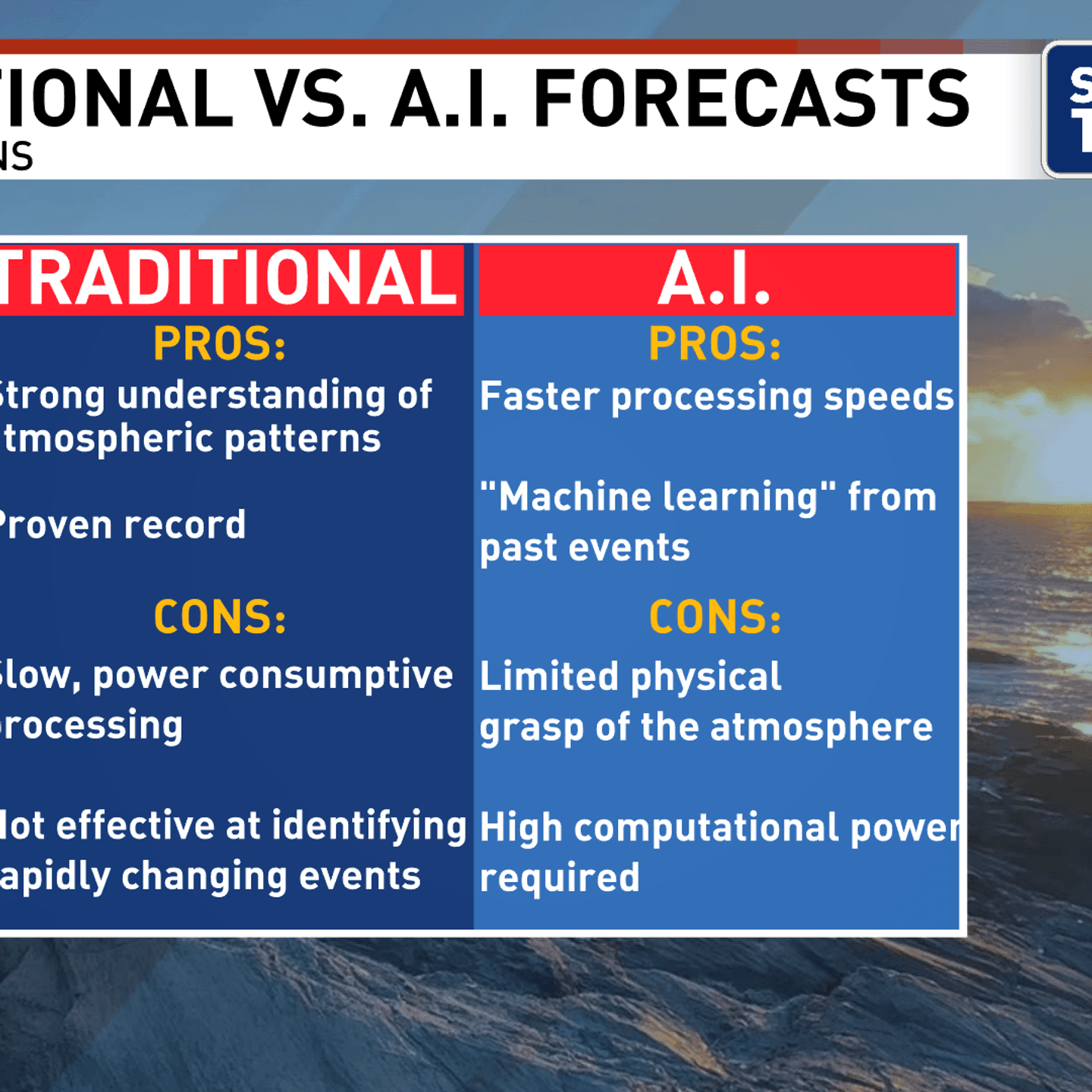
Think about it. Traditional weather forecasting is built on decades of understanding atmospheric physics. Meteorologists use complex mathematical models that simulate the atmosphere’s behavior. These models are powerful, no doubt. They consider temperature, pressure, humidity, wind – all the big players. But they’re also incredibly computationally expensive and, frankly, a bit slow to react to rapid changes. It’s like trying to steer a giant oil tanker with the precision of a speedboat.
And that’s where the magic, or rather the algorithms, of AI come in. Artificial intelligence, particularly machine learning, is learning to forecast weather by analyzing massive amounts of historical data. It’s not necessarily understanding the physics in the same way humans do; it’s recognizing patterns. It spots correlations and trends that might be too subtle or complex for even the most brilliant human mind to grasp from raw data alone. We’re seeing AI models outperform traditional methods, and it’s happening fast.
The Old School: Physics-Based Models
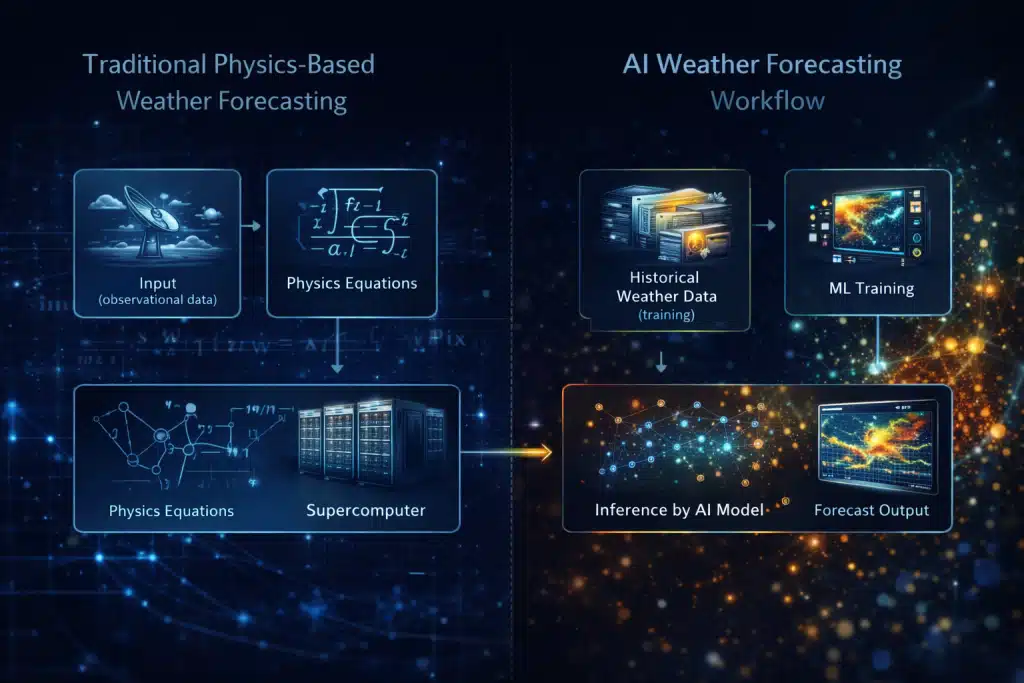
So, what exactly are these traditional methods we’re talking about? They’re the bedrock of modern meteorology. We’re talking about numerical weather prediction (NWP) models. These bad boys use the laws of physics – fluid dynamics, thermodynamics – to create a simulation of the atmosphere. You feed them current weather observations from all over the globe (satellites, weather balloons, ground stations), and they churn out predictions hours, days, or even weeks out.
The process is intensive. It requires immense computing power, and the models themselves are complex beasts, often ruing into millions of lines of code. They’re constantly being refined, updated with new data and better scientific understanding. For a long time, they were the absolute gold standard. When you saw that spaghetti chart of predicted storm tracks, that was NWP in action. It’s a testament to human ingenuity and our deep understanding of physical laws governing our planet.
Source : visualcrossing.com
But here’s the kicker: these models can struggle with extreme events or rapidly developing weather patterns. Think sudden, intense thunderstorms or microbursts. They might forecast them, but the precise timing and location can be hit or miss. Why? Because the real atmosphere is chaotic. Tiny variations can lead to vastly different outcomes, and while physics describes the rules, predicting the exact play-by-play is tough. It’s like trying to predict the exact ripple effect in a pond after dropping a single pebble; the initial conditions are key, and even a slight difference matters.
Enter the New Kid: AI and Machine Learning
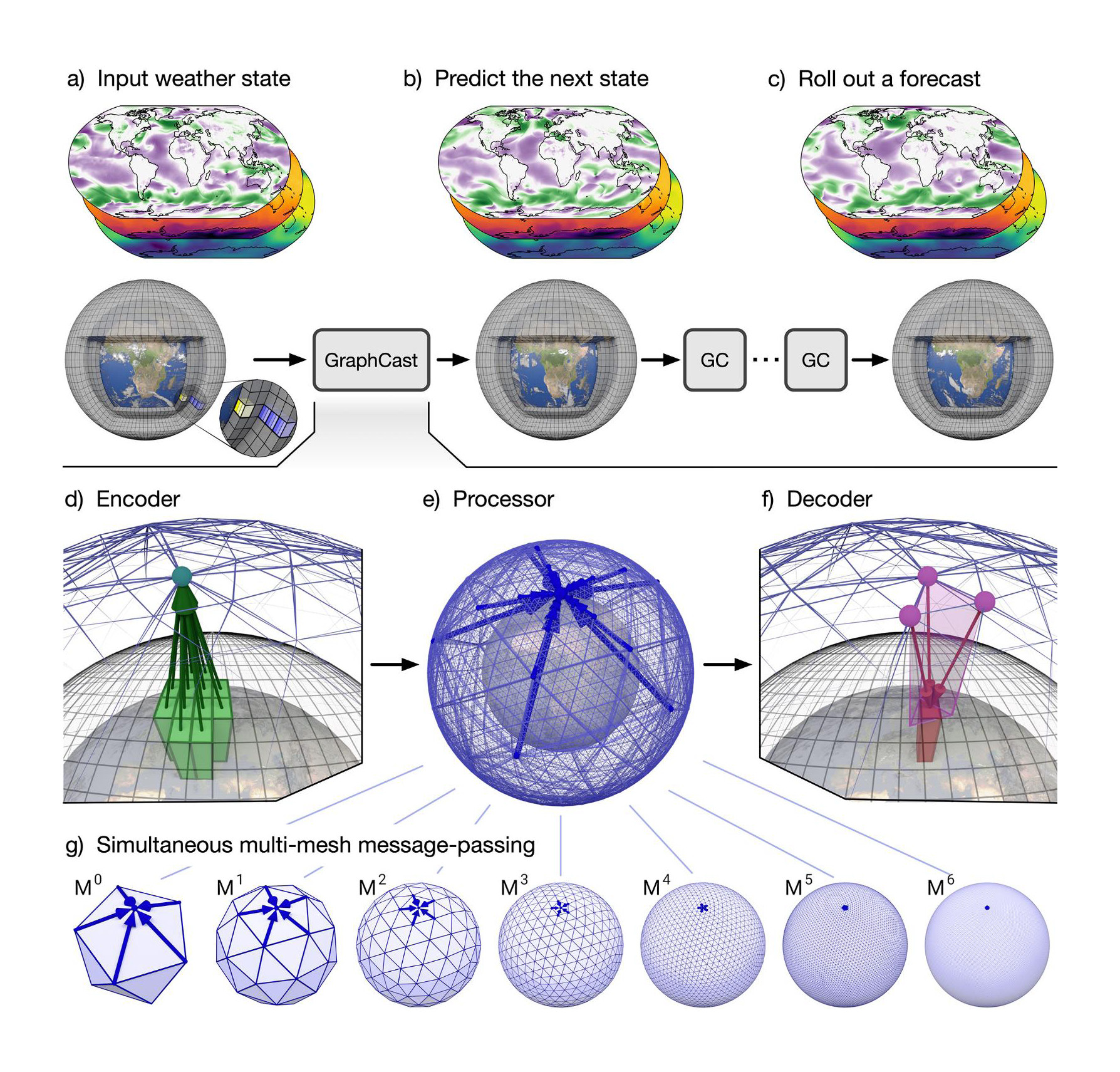
Now, let’s talk about the disruptors: AI and machine learning. Instead of solving differential equations, AI models learn by example. They’re trained on years, decades, even centuries of past weather data – temperature, precipitation, wind, you name it. They look at what happened before and learn to predict what will happen next. It’s less about why and more about what.
This approach has some serious advantages. For starters, AI can process vastly more data than traditional models. Think of every sensor, every observation, every historical forecast – AI can ingest it all and find coections. This allows them to identify subtle patterns that might be missed by physics-based models. You can find more about this evolution in resources like AI forecasting models vs. traditional weather prediction.
And the speed? Oh, the speed! Once an AI model is trained, ruing a forecast can be incredibly quick. We’re talking minutes, not hours. This is a massive deal for things like nowcasting – predicting what’s going to happen in the next hour or two. Imagine getting an alert on your phone before that sudden downpour hits your picnic. That’s the power of fast AI weather prediction.
One of the most mind-blowing aspects? Sometimes, AI models are better even when they don’t fully understand the underlying physics. Marketplace reported on how scientists are baffled by why AI models are so good at weather forecasting, even when they aren’t explicitly programmed with all the physical laws. It’s like a kid learning to ride a bike just by watching and trying, without a textbook explanation of torque and gravity. It just works. This is a key reason why AI models are good at weather forecasting, often surprising the experts.
The Accuracy Arms Race
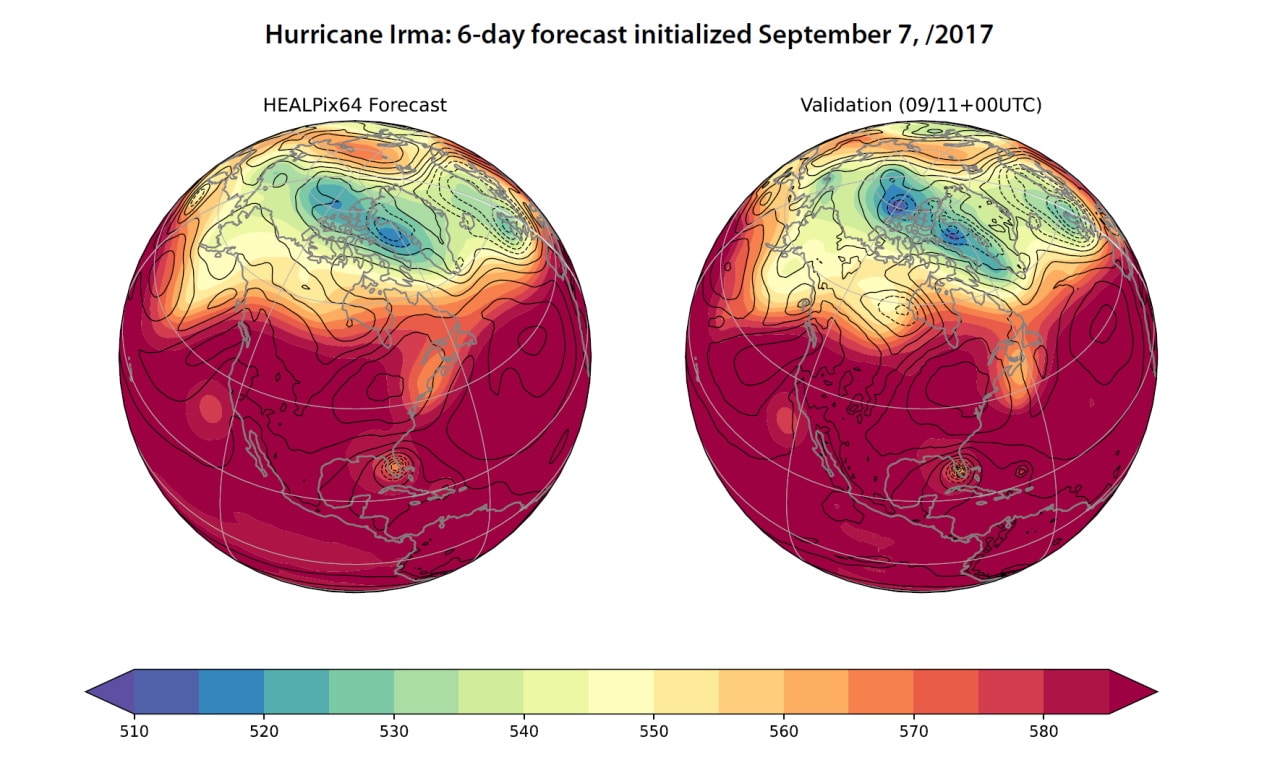
Okay, so AI is fast and can handle tons of data. But is it actually more accurate? The answer, increasingly, is yes. Especially for certain types of forecasts. AI models have been shown to outperform even the most sophisticated traditional models in predicting short-term precipitation and extreme weather events. They can sometimes nail the timing and intensity with a precision that NWP models struggle to match.
Think about predicting flash floods or severe thunderstorms. These are fast-evolving, localized events. Traditional models, with their longer computation times and coarser grids, can sometimes be too slow to catch them. AI, with its pattern recognition and rapid processing, can often provide earlier and more accurate warnings. This is a massive step forward for public safety and preparedness.
It’s not always a clean sweep, though. For longer-range forecasts (like predicting the general weather pattern for two weeks out), traditional physics-based models still hold a lot of weight. They are built on fundamental science and provide a solid framework. AI models, while improving, can sometimes struggle with the long-term accumulation of errors or predicting large-scale climate shifts without that solid physics foundation.
Source : blogs.nvidia.com
However, the gap is closing. Recent advancements in AI are allowing these models to incorporate physics more directly, creating hybrid approaches. They’re not just pure pattern-matchers anymore; they’re learning physics-informed patterns. This is where things get really interesting. We’re seeing models that combine the speed and data-handling power of AI with the scientific rigor of physics. How AI models are outperforming traditional weather forecasting is a complex story, but the results speak for themselves.
The Data Deluge: Fueling the AI Fire
One of the biggest drivers behind AI’s success in weather forecasting is the sheer explosion of data available today. Satellites are constantly beaming down high-resolution imagery. Ground sensors are more numerous and sophisticated than ever. Radar systems provide real-time precipitation data. Weather balloons, buoys, aircraft – the list goes on. This deluge of information is the perfect fuel for AI algorithms.
Traditional models have always used data, of course. But AI can ingest and analyze this data in ways that are simply not feasible with NWP. It can find those faint signals in the noise, those subtle precursors to significant weather events. It’s like having an infinitely patient analyst who can sift through mountains of information without getting tired or missing a single detail. This ability to process massive datasets is a game-changer.
Moreover, AI can learn from forecast errors. If a traditional model misses a storm, or gets the intensity wrong, that information can be used to retrain and improve the AI. It’s a continuous learning loop, constantly refining its predictions based on real-world outcomes. This adaptive learning is something traditional models can’t do in quite the same way. They rely on human experts to analyze errors and manually update the code.
Real-World Impact: Beyond Just Knowing the Weather
So, why should you care if AI is better at predicting rain? Because accurate weather forecasts have a massive impact on our lives and economies. For farmers, it means knowing when to plant and harvest, saving crops from frost or drought. For airlines, it means safer and more efficient flight paths, saving fuel and preventing delays.
Think about disaster preparedness. Faster, more accurate warnings for hurricanes, tornadoes, or severe floods can save lives and reduce damage. Emergency services can be deployed more effectively. Businesses can make better decisions about supply chains, energy management, and construction projects. It’s not just about carrying an umbrella; it’s about economic stability and human lives.
The energy sector, in particular, is a huge beneficiary. Predicting wind and solar output is crucial for grid stability. AI models can provide more reliable forecasts of renewable energy generation, helping to integrate these intermittent sources more smoothly into the power grid. This is vital for our transition to a cleaner energy future. The potential for optimization in energy grids is enormous.
And for us regular folks? It means fewer rained-out weekends, better plaing for outdoor activities, and a greater sense of security knowing that potentially dangerous weather is being predicted with increasing accuracy. It’s about reducing uncertainty in a fundamentally uncertain world.
Source : arstechnica.com
The Future: A Hybrid Horizon
The future of weather forecasting isn’t likely to be a strict either/or scenario. It’s not going to be purely traditional models or purely AI. The real power lies in the convergence. We’re already seeing hybrid models emerge, where AI techniques are used to improve specific components of traditional NWP models, or where AI forecasts are used as a valuable ‘second opinion’ to human forecasters.
These hybrid systems aim to get the best of both worlds: the deep scientific understanding and long-range stability of physics-based models, combined with the speed, data-handling capacity, and pattern-recognition prowess of AI. Imagine a system that uses AI to quickly identify a developing severe weather threat, then employs detailed physics models to simulate its exact trajectory and impact. That’s the dream, and it’s becoming a reality.
Companies are investing heavily in this space. The drive for better weather predictions is pushing iovation at an incredible pace. While traditional methods laid the groundwork, AI is the accelerant, pushing us toward a future where weather forecasts are not just accurate, but almost prescient. It’s a fascinating time to be watching the skies – and the algorithms that predict them.
It’s clear that AI isn’t just a fad; it’s fundamentally reshaping how we understand and predict the weather. Traditional methods provided the ‘what’ and ‘why’ based on physics. Now, AI is adding an unprecedented level of speed, detail, and accuracy, often by finding patterns we never knew existed. The ongoing developments mean we can expect improved forecast accuracy across the board, making our lives safer and more predictable in the face of nature’s constant variability.
Frequently Asked Questions
Are AI weather models always more accurate than traditional ones?
Not always. For long-range forecasts (weeks out) and predicting large-scale atmospheric patterns, traditional physics-based models often still hold an edge due to their scientific foundation. However, for short-term predictions, nowcasting, and specific events like thunderstorms or heavy rain, AI models are increasingly proving to be more accurate and faster. It really depends on the specific forecast task.
How much faster are AI weather models?
Significantly faster, especially once they’re trained. While traditional numerical weather prediction models can take hours to run on supercomputers, a trained AI model can often generate a forecast in minutes or even seconds. This speed is crucial for rapidly evolving weather situations and issuing timely warnings.
Do AI weather models understand the physics of weather?
That’s the million-dollar question! Traditional models are built on physics. AI models primarily learn from data and patterns. While some advanced AI models are now being designed to incorporate physical principles (physics-informed AI), many still achieve high accuracy by recognizing complex relationships in data without explicit knowledge of the underlying physics. It’s a bit like knowing that hitting a ball makes it fly, versus knowing exactly why based on forces and trajectory calculations. Both can get the job done, but differently. This is a key area of research, impacting AI forecasting capabilities.
What kind of data do AI weather models use?
AI weather models use a massive amount of data, similar to traditional models, but can often process it more efficiently. This includes data from satellites, weather balloons, ground-based sensors, radar, buoys, and even historical weather records stretching back decades. The sheer volume and variety of this input weather data is what allows AI to identify subtle patterns and make surprisingly accurate predictions.
Will AI replace human meteorologists?
Highly unlikely. AI models are powerful tools, but they lack the human intuition, experience, and the ability to contextualize forecasts. Human meteorologists are essential for interpreting model outputs, communicating uncertainty, understanding local effects, and making critical decisions during severe weather events. AI is more likely to become a powerful assistant for meteorologists, enhancing their capabilities rather than replacing them entirely.